China’s Economic Miracle

Here is a place where you can explore how China realized a economic miracle in the last 40 years

More about my project

China’s rapid economic growth from the last 40 years is fascinating to people all over the world. For my senior project, I explored China’s rapid economic growth since the Reform and Opening Up started in 1978 and continues today. I included economic, political and social features of China in this period. My product includes visual digital displays of important events and trends that are related to China’s economic growth. I  designed infographics including graphs and charts to display the information, and included images and written commentary. I chose this topic because this event is closely related to my life. My family's life has improved a lot, which has enabled me to study in the US.  I also want to show people from other countries how China has gone from poverty to wealth in just a few decades.

Overview of China’s Economic Miracle

Before 1978, China’s economy and society were shaped by a highly centralized planned system. After the founding of the People’s Republic of China in 1949, the government adopted a Soviet-style model. This model emphasized state ownership, collective agriculture, and price controls (Encyclopedia Britannica). This system led to inefficiency, low productivity, and shortages for goods. During the Great Leap Forward and the Cultural Revolution, economic growth stagnated, the education system collapsed, and people lived in fear. 

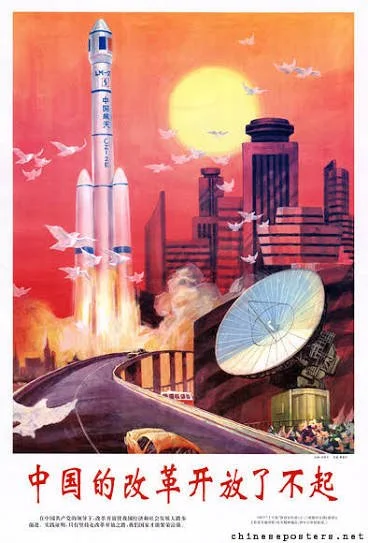
This turning point came in December 1978. At the Third Plenary Session of the 11th Central Committee, the Chinese Communist Party officially launched the policy of reform and opening up (Wikipedia). Under the leadership of Deng Xiaoping and other reformers in the CCP, the aim of reform and opening-up was to shift from an inefficient planned economy to a market-oriented economy integrated within the global economy. Over the 40 years, these reforms reshaped China’s economy, society, and global role, changing from an isolated state to the world’s second largest economy. 

The earliest reforms began in rural areas. The introduction of the household responsibility system replaced collective farming, allowing farmers to choose crop types and sell the remaining grain after reaching the annual collection standard. Agricultural productivity rose sharply, food shortages declined, and rural incomes increased, providing foundation for future urbanization. 

The introduction of Foreign Direct Investment was an important factor in the rapid development of China’s economy. China began to attract FDI in 1979, from 80,000 USD in 1979 to 344.07 billion USD in 2021 (World Bank). China also began opening to the global economy through Special Economic Zones. These zones offered tax incentives and other benefits to attract foreign investment. Shenzhen transformed into a world-class metropolis from a small fishing village. 

Economic reform deeply affected society. Started in 1977, the government restored Gaokao, revived universities and encouraged overseas studies; these policies have raised the education level of the next generation of Chinese people and also enabled China to cultivate talents in all fields. With the development of the economy, more voices emerged. Women and LGBTQ community have also begun to speak out for themselves. 

China’s reform path deliberately separated economic liberalization from political liberalization. The sequencing of FDI openness before the SOEs reform and legalization of private enterprise contributed to strengthening the state instead of losing the central power (Gallagher). While some political reforms were introduced in the 1980s, the Tiananmen crisis brought an end to China’s democratization process.

China’s reform and opening up can be defined as a fundamental change in the structure of the state. It constructed China from a relatively closed, centrally planned economy to a globally dynamic economy. It reshaped the economy, social structure and people’s lives. Yet it preserved the Chinese Communist Party’s power and created new challenges for the country. Overall, the positive effects of reform and opening up outweigh the negative ones. Today, China’s economic boom, institutional style, and its global role are all consequences attributed to the reform and opening up.

Gallagher, Mary E. “‘Reform and Openness’: Why China’s Economic Reforms Have Delayed Democracy.” World Politics, vol. 54, no. 3, 2002, pp. 338–72. JSTOR, http://www.jstor.org/stable/25054191. Accessed 4 Nov. 2025.

Liu, James T.C., "China". Encyclopedia Britannica, 4 Jan. 2026, https://www.britannica.com/place/China. Accessed 5 January 2026.

Wikipedia, “Reform and Opening Up.” Wikipedia, Wikimedia Foundation, 23 Dec. 2025, en.wikipedia.org/wiki/Reform_and_opening_up.

World Bank, “Foreign Direct Investment, Net Inflows (BOP, Current US$) - China.” World Bank Open Data, data.worldbank.org/indicator/BX.KLT.DINV.CD.WD?locations=CN. Accessed 5 Jan. 2026.

Inequality

Inequality of Development in Coastal vs. Inland Provinces

During China’s reform and opening up, a significant inequality of development emerged between the coastal and inland regions. The coastal provinces were prioritized for investment and established Special Economic Zones (SEZs), such as Shenzhen, Xiamen and Shantou. These SEZs created suitable environments for foreign business to operate in, as private property rights were well protected and tax incentives were provided to attract foreign investors.(Zakalskiy) Due to the benefits of geographical location and the assistance from government policies, coastal provinces rapidly urbanized and integrated into the global economy. These regions became the center of manufacturing and export.

In contrast, many inland provinces, especially in the west and northeast, had fewer opportunities to gain investment and have access to the global economy. Inland areas’ economies relied heavily on agriculture and heavy industry. A massive state-owned enterprise (SOE) plan was launched on a national scale in the 1990s. One of the major reasons is that a reform policy, which introduced market competition against SOEs and encouraged private enterprises development, was formulated in 1992.(Fang) The layoffs in the state-owned enterprises caused the economies of the interior provinces, especially three northeastern provinces, to suffer a severe decline. The problem of long-term loss of young population and economic stagnation still continues today. As a result, income gaps widened between the coastal and inland areas, with coastal provinces achieving far higher GDP. For example, coastal provinces account for half of China’s GDP, while twice as many inland provinces account for the other half. This regional imbalance has become a major problem of China’s reform and opening up. 

Fang, Hanming. “Reluctant Entrepreneurs: Evidence from China’s SOE Reform.” Reluctant Entrepreneurs: Evidence from China’s Soe Reform, 9 Oct. 2023, voxchina.org/show-3-328.html. Accessed 06 Nov. 2025.

Vitaly Zakalskiy (LBS MiM. “Special Economic Zones Unveiled: Lessons from China’s Success...” WheelerBlog, 12 Feb. 2025, wheelerblog.london.edu/special-economic-zones-china/. Accessed 06 Nov. 2025.


Education in China

Education in China

In the late 1970s, as China was under the shadow of the Cultural Revolution, classrooms across the country were silent, textbooks were destroyed, and students were forced to participate in the uprising. Following Mao’s death in 1976, which marked the end of the Cultural Revolution, Gaokao returned in late 1977 by the decision made by Deng. Millions of people took the Gaokao and rushed back to school after almost 10-year no schooling. Education reform in China has been carried out amid economic reform. In 1986, an act that gave hundreds of millions Chinese young men the opportunity to receive education was implemented. From then on, the vast majority of people, who are the keystone of China today, received education. The education reform has offered China the opportunity to engage in high-tech industries, rather than low-end industries. 

Admittedly, China’s education system after the reform significantly enhanced the educational level of society, it also brought big pain to an entire generation of students. Students in China suffered in the exam-driven education system. Teachers and parents prioritized scores over anything else such as innovation and critical thinking. In this situation, the pressure that students suffer is unbelievable. Here is a schedule of students’ daily life in Hebei-very competitive environments for Gaokao. Students were forced to wake up at 5:30am and take 10 classes per day with little break. The interesting thing is that most students obeyed or even liked this policy. Students notice Gaokao and hardworking may be their only chance to get rid of poverty and change their classes. One of the sad things is that people seldom change their classes by going to the college unless those top universities. In 2022, the graduating students from universities in China had exceeded 10 million people. However, there are no corresponding high-paying jobs in society that match this huge number of people. More and more people who graduate from universities have to take jobs that aren’t jobs they anticipated, such as delivery people or taxi drivers. Even though there were new policies(“Double Reduction”) that tended to reduce students' pressure, China’s education still has a long way to go. 

Special Economic Zones in China

 SEZs in China

When China first opened its doors to the world in 1978, the country stood at a crossroad. The Chinese government made a significant decision to gain Foreign Direct Investment (FDI). The idea of small experimental zones along the coast emerged. These places were called Special Economic Zones (SEZs). The methods of SEZs’ attracting FDI were done by offering lower corporate income tax rates, access to talent, and intellectual property protection (Acclime China). The development of China’s SEZs began dynamically with the four earliest SEZs designated—Shenzhen, Xiamen, Shantou, and Zhuhai. 

Shenzhen, once a fishing village, became the most successful result of the SEZs policy. Investors from all over the world rushed in., Factories were built one after another, skyscrapers rose where rice fields once stood, and new landmark structures appeared every several years. Shenzhen’s success strengthened the Chinese government’s confidence in the idea of SEZs. As a result, more and more zones with different purposes emerged, such as Free Trade Zones and High-tech Development zones (Cash).

Among all these zones, Shanghai’s Pudong New Area stands as the most dramatic transformation of all. Shanghai can be clearly defined as two areas: Pudong and Puxi. Puxi is located to the west of the Huangpu River that flows through the city, while Pudong is to its  east.. Before 1992, Pudong was regarded as a rural area by the people of Shanghai. Farmland and a few warehouses were people’s impression of Pudong. At that time, a saying was widely spreading, “Rather have a bed in Puxi than a whole house in Pudong.” However, everything changed when the approval of the Pudong New Area launched in 1992. Bridges spanned the Huangpu River, Liujiazui has transformed from a low-income area into China’s most important financial center, and the largest and busiest airport in China has also been constructed in Pudong. By the 2010s, Pudong had become a symbol of China’s rise: a forest of skyscrapers, a center of finance and technology, and a diverse area where Chinese and foreign cultures blend together.

Acclime China. “Special Economic Zones (Sezs) in China for Foreign Investment & Manufacturing.” Acclime China, 29 Nov. 2024, china.acclime.com/guides/special-economic-zones-foreign-investment-manufacturing/. 

Cash, Joe. “China Launches $113 Billion Free-Trade Experiment on Hainan Island | Reuters.” Reuters, 18 Dec. 2025, www.reuters.com/world/china/china-launches-113-billion-free-trade-experiment-hainan-island-2025-12-18/. 

Agricultural Reform

Intro of Agricultural Reform

China’s agricultural reform since 1978 marked a turning point in the country’s economic and social development. Before 1978, China’s rural areas operated under the communal system, where use of land and what goods to produce were decided by local governments (Asia for Educator). Local governments were also unable to make decisions by themselves; instead, they had to follow the arrangements of the central government. Although this system aimed for efficiency, it has constantly encountered problems in the actual operation process. At that time, around 800 million people worked in agriculture, meaning any reform would affect most of the population. 

A pioneer farmer from Anhui first made changes to the communal system which is later called Household Responsibility System in 1978 (Ni). This experiment was later endorsed as national policy in 1982. Under this system, land remained collectively owned, but households were allowed to manage their own crops and keep surplus production after meeting state quotas. This policy greatly increased farmers’ motivation, leading to rapid growth in grain output and higher rural incomes. 

During the late 1980s and 1990s, agricultural reform expanded beyond farming itself. Rural industrialization developed, with township and village enterprises providing jobs (Chen).  As a result, labor gradually shifted from agriculture to industry and services, accelerating urbanization. The infographic shows a clear decline in the rural population and a rise in urban population after 1979. 

Further reforms continued in the 2000s. In 2006, China abolished the centuries-old agricultural tax, reducing the financial burden on farmers (Our China Story). Since 2013, policies have focused on rural modernization, emphasizing mechanization, large-scale farming, technological innovation, and sustainability, 

Overall, China’s agricultural reform since 1978 transformed a low-efficiency collective system into a more productive, market-oriented rural economy. It not only ensured food security but also took millions of people out of poverty. 

Asia for Educators, Columbia University. “The Commune System (1950s).” Asia for Educators | Columbia University, afe.easia.columbia.edu/special/china_1950_commune.htm. Accessed 7 Jan. 2026. 

Chen, Hongyi. “Township and Village Enterprises - Chinese Studies - Oxford Bibliographies.” Oxford Bibliographies, 25 Feb. 2016, www.oxfordbibliographies.com/display/document/obo-9780199920082/obo-9780199920082-0128.xml. Accessed 7 Jan. 2026

“China Decided to Abolish Agricultural Tax: Today in History: Fun Fact.” Our China Story, Our China Story, 24 Dec. 2024, www.ourchinastory.com/en/13716/China-decided-to-abolish-Agricultural-Tax. Accessed 7 Jan. 2026

Ni, Dandan. “The Farmer Who Changed China Forever.” #SixthTone, 21 Aug. 2018, www.sixthtone.com/news/1002783. Accessed 7 Jan. 2026.